
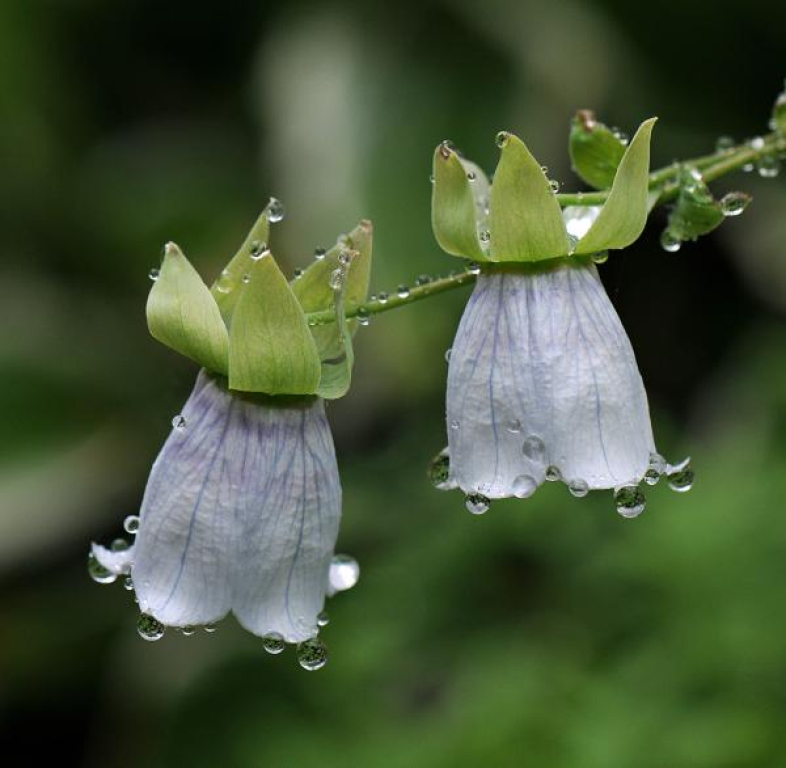
Codonopsis clematidea produces a carrot-like taproot. Rather weak stems arise up to 100 cm although 40-60 cm is more usual. In full sun and cooler climates, the stems are able to support themselves otherwise grow it where neighbours can provide some gentle support. The leaves are grey-green with a mat-like finish. If bruised, they emit a distinct skunk-like odour. If cut, they exude a milky sap. The bell-like flowers are in loose terminal clusters. Each flower is 2-2.5 cm long, pale blue with intricate internal markings. It is worth peering inside the flowers to appreciate the kaleiodoscope-like markings. It is native to mountain forests, ravines and streamsides at 1700-2500 m. Its distribution includes western China, NW India, Afghanistan, Kazakhstan, Kyrgyzstan, Pakistan and Tajikistan.
June or July.
This plant requires cool site with deep, rich soil that is well-drained. It prefers soil pH that is on the acidic side. In cooler regions, full sun is ideal but in warmer summer regions, part-shade is preferred. It is hardy from zones 4-8.
By seed