
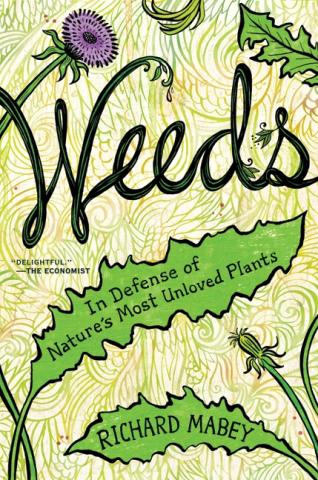
Weeds: In Defense of Nature’s Most Unloved Plants, Richard Mabey,HarperCollins Publishers, New York, New York (June 28, 2011), 336 pages, hardcover; publisher’s price: $25.99; Amazon price: $17.15.
Richard Mabey is one of Britain’s foremost nature writers, and even a quick glance atWeeds shows why. It is, at once, erudite, witty, insightful, and full of allusions to the many facets of human knowledge: history, botany, agriculture, literature, and so much more. That he uses common weeds as the kernels around which to accrete his stores of information is astonishing.
“Weeds are mobile, prolific, genetically diverse,” Mabey writes. “They are unfussy about where they live, adapt quickly to environmental stress, use multiple strategies for getting their own way. It’s curious that it took so long for us to realize that the species they most resemble is us.”
Of course, we gardeners are on the most intimate terms with weeds. We attempt to draw a firm line between “nature and culture, wildness and domestication,” Mabey writes. Weeds belong to nature and wildness, and relentlessly invade our gardens of cultivated plants. He points out the fine irony that “weeds are found most abundantly where there is the most weeding; that notion ought to make us question whether the weeding encourages the weeds as much as vice versa.”
Mabey praises weeds as the “progenitors of all the plants that keep us alive,” for before cultivation, selection, and hybridization, our vegetables, herbs, and low-growing fruits existed as wild weeds and kept the human race going. He reflects on the theory that agriculture developed in the Fertile Crescent region of the Middle East when gatherers brought home the seeds of the weedy emmer grass that then sprang up around settlements. Eventually, through selection, this yielded our modern wheat.
Chapters are devoted to delicious information that springs from his musings about specific weeds, such as thoroughwort, love-in-idleness, and gallant-soldier. These are British common names, so American readers may want to refer to the book’s glossary of plant names that at least gives botanical names.
The best testimonial I can give to this excellent book is that within 10 minutes of finishing it, I found myself in a roadside patch of wild weeds, seeing them as I had never seen them before.
Jeff Cox is a contributing editor of Horticulture magazine and has written 15 books on gardening. He lives in Kenwood, California.